Our project, which involved the production of interlocking piles with a concrete initial setting time of 40-70 hours, initially seemed straightforward. However, we encountered some unexpected deviations during the test. While the initial setting time of concrete generally varies with temperature, the differences are usually manageable. Yet, when we extended the setting time, we observed extreme phenomena in air humidity, air isolation, and underwater environments that we had not anticipated.
Our project, which involved the production of interlocking piles with a concrete initial setting time of 40-70 hours, initially seemed straightforward. However, we encountered some unexpected deviations during the test. While the initial setting time of concrete generally varies with temperature, the differences are usually manageable. Yet, when we extended the setting time, we observed extreme phenomena in air humidity, air isolation, and underwater environments that we had not anticipated.

After the collapsed test block was re-mixed, it regained its plasticity. The visual slump was still 150mm, and the workability was good. My analysis is that the cement could not be hydrated, or the hydration rate was prolonged due to the excessive retarder for a very long time, and the water in the concrete evaporated. Although a certain proportion of cement participated in the hydration and provided strength, most of the cement inside was not set initially. The cement in the shallow layer of the test block mainly formed “soil blocks” after losing water. At the same time, this “soil block layer” formed a slightly strong structure and prevented the evaporation of water inside the concrete. After being placed in the standard curing room, the cement in the shallow layer of the test block reabsorbed water and gained fluidity.
The first test failed, but the result was that increasing the retarder can significantly extend the setting time of concrete, and exceeding the limit will cause the concrete never to be set. Concrete made of retarder, accounting for 0.6% of the concrete adhesive, can finally be set under open conditions, but the strength is meager and can even be broken by hand. It will entirely fall apart after being put into the water again for some time. It was not set for 40 days in a closed environment (sealed in a plastic bag and sealed in water). After 40 days, I threw away the test block and did not continue to observe. I did not calculate the exact ratio. It should be said that the proportion of white sugar and sodium gluconate mixed in half and more than 0.5% of the adhesive will block the cement hydration reaction.
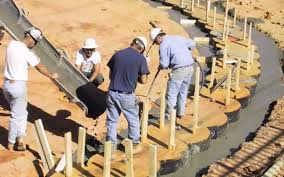
In the subsequent experiments, in addition to using white sugar and sodium gluconate, there was a retarder of unknown composition called super retarder. After concrete is formed, it is no longer stored in a single environment. Three environments are used to simulate construction conditions as much as possible: 1. Covering the outdoor surface with plastic film; 2. Standard curing room with saturated humidity; 3. Underwater closed environment: This test was relatively smooth, and the initial setting time of outdoor film covering will be shorter than that of a standard curing room and underwater. The concrete state in the standard curing room and underwater also meets the initial setting time of 40-70 hours. The 15-day strength of concrete in a standard curing room and underwater state is lower than that of concrete covered with outdoor film. The 28-day strength of concrete stored in the three environments can reach the design strength.
The interlocking pile is part of the circumference between adjacent concrete piles, and a steel cage is inserted into the piles. Later, the piles are constructed in sequence to form an overall continuous waterproof and retaining enclosure structure with an excellent anti-seepage effect.
Interlocking piles are a foundation pit retaining structure that forms an interlocking arrangement between piles. The piles are arranged in an interlaced manner: one unreinforced super-slow-setting concrete pile (A pile) and one reinforced concrete pile (B pile) (constructed using a full-casing drill rig). Pile A is built first, followed by pile B, and the construction of pile B is completed before the initial setting of the concrete of pile A. Both piles A and B are constructed using a full-casing drill rig, and the concrete of the intersecting part of adjacent piles A is cut off to achieve interlocking.
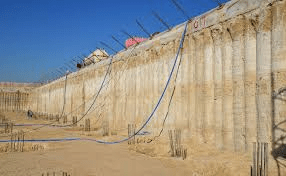
The construction points are as follows:
(1) The construction of concrete guide walls is vital to ensure the accurate positioning of the interlocking piles. This not only ensures the stability of the drilling rig but also guarantees the safety of the construction load.
(2) The drilling process begins with the hoisting of the first casing section. It’s crucial to control the verticality of the casing and use an inclinometer to detect any deviation. Immediate correction is necessary to maintain the integrity of the piles. Once the hole is formed, the casing is pulled up section by section as the concrete is poured.
(3) Concrete pouring: During the construction of pile B, pile A must be cut. When the concrete of pile A has not reached a particular strength, the grinding and cutting of the casing drill will damage the concrete of pile A. Therefore, a construction plan is adopted to delay the initial setting time of pile A concrete and construct pile B when the concrete of pile A is not in the initial setting state. According to the test, after adding a type setting water-reducing agent, the initial setting time of concrete can be delayed to about 60h (determined according to the construction equipment and construction speed), thus ensuring the operability of the construction plan. Concrete is poured by the conduit method. If there is a lot of water seepage at the bottom of the hole and the water inflow exceeds 1 cubic meter/hour, underwater concrete pouring is adopted.

 concrete admixture
Leave a comment