“Sand” is a natural particle gradation with no mud, dirt, or debris restrictions. It is a general name. “Sand” means soil that can be used as a building material and has specific quality requirements. For example, highly weathered granite particles cannot be called “sand” even though they are very similar. The main reason is that it could be of better strength and quality. The definition of “sand” in construction materials is stones continuously distributed in a specific particle size range. Sand and stone have different particle sizes but belong to the same material.
When doing mortar tests, the most common situation is the pure desalted sand test. First, the slurry does not flow using 1.5g of mother liquor. Later, even if the amount of water-reducing agent is increased, the expansion can only be increased to 220mm. After this, even increasing the amount of admixture without a limit will not give the mortar good fluidity. After the mortar is finally set, you will find that the surface of the formed test block with pure desalinated sand is very rough, and the sand can be removed by gently rubbing it with your hand.
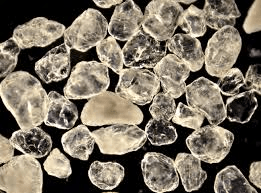
The test block made of pure desalinated sand has too few particle sizes below 0.35mm, so the cement slurry cannot completely wrap all the sand. There are too many voids in the desalinated sand, so the slurry cement paste is not fully filled. This is also reflected in the weight of the mortar test block. The test block of pure desalinated sand is the lightest. It is even 111g lighter than the test block made from standard sand. Why can’t the same cement slurry wrap the desalinated sand with a smaller specific surface area? I think it may be that although sand below 0.35mm does not participate in cement hydration, it can increase fluidity in the physical space, similar to cement and other glue materials. To verify this idea, I added a set of control experiments with a glue dosage of 410 at the end of the experiment. The expansion of mortar made from the same desalinated sand was found to be significantly improved.
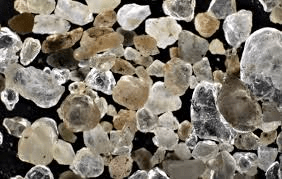
The water consumption of standard sand mortar is much less than that of machine-made and desalinated sand. This is related to the smooth surface of standard sand and no impurities. Although the water consumption of standard sand mortar is small, the expansion is not greater than that of machine-made sand. It can be seen in the microscopic state that even if the machine-made sand particles are irregular, it does not affect the fluidity of the mortar.
It is well known that an increase in the air content of concrete will reduce its strength. People are inherently concerned about changes in the air content of concrete caused by admixtures. The above tests show that the changes in air content caused by unreasonable gradation of sand cannot be underestimated. The determination of the gas content in this test was based on overall density reasoning and was not measured.

 concrete admixture
Leave a comment