Fly ash is fine ash collected from the flue gas after coal combustion and is the main solid waste discharged from coal-fired power plants. To improve the combustion efficiency of coal, thermal power plants will not directly burn whole blocks of coal. First, the coal needs to be ground into powder. Pulverized coal burns in a suspended state in the furnace. Most of the combustibles in the coal can be burned out in the stove, while many incombustible (mainly ash) in the pulverized coal are mixed in the high-temperature flue gas. These non-combustible materials are partially melted due to the high temperature, and at the same time, due to the effect of their surface tension, many fine spherical particles are formed. Under the action of the induced draft fan at the end of the boiler, the flue gas containing a large amount of ash flows to the end of the furnace. As the flue gas temperature decreases, part of the molten fine particles become vitreous after rapid cooling, and these vitreous have high potential activity. Before the induced draft fan discharges the flue gas into the atmosphere, the dust collector separates and collects those mentioned fine spherical particles, which are fly ash.
1. Three significant effects of fly ash
(1) Morphological effect
Under a microscope, fly ash contains more than 70% glass beads, with complete particle shape, smooth surface, and dense texture. This form can undoubtedly play a role in reducing water, densifying and homogenizing concrete, promoting the deflocculation effect of initial cement hydration, changing the rheological properties, initial structure, and various functions of the mixture after hardening, and is very important for pumping. It can provide good lubrication for concrete.
(2) Activity effect
The chemical components in fly ash contain active silica and aluminum oxide, which react chemically with alkaline substances such as calcium hydroxide in a humid environment to form gelling substances such as hydrated calcium silicate and aluminate. These substances strengthen the concrete and block the capillary tissue, improving its corrosion resistance.
(3) Micro-aggregate effect
The tiny beads and debris in fly ash are equivalent to unhydrated cement particles in concrete. The tiny beads are equivalent to active nanomaterials, which can significantly improve concrete’s structural strength and homogeneity.

2. The effect of fly ash on concrete
(1) Increase the workability of concrete
Adding an appropriate amount of fly ash can improve concrete’s fluidity, cohesion, and water retention, making the concrete easier to pump and pour and reducing the slump loss over time.
(2) Reduced heat of hydration of concrete
Fly ash hydration releases very little heat, which can reduce the heat release of concrete and significantly reduce temperature cracks. This is particularly beneficial for large-volume concrete projects.
(3) Improved durability of concrete
Secondary hydration increases concrete’s compactness and improves its interface structure. At the same time, the secondary reaction reduces the amount of calcium hydroxide susceptible to corrosion. Therefore, adding fly ash can improve concrete’s impermeability and resistance. Sulfates are corrosive. At the same time, due to its large specific surface area and strong adsorption capacity, fly ash can absorb alkali in cement and react with it to reduce the alkali content.
(4) Cost reduction
Adding fly ash can reduce the cement dosage by about 10% for concrete with the same strength.

3. Varieties and performance indicators of fly ash
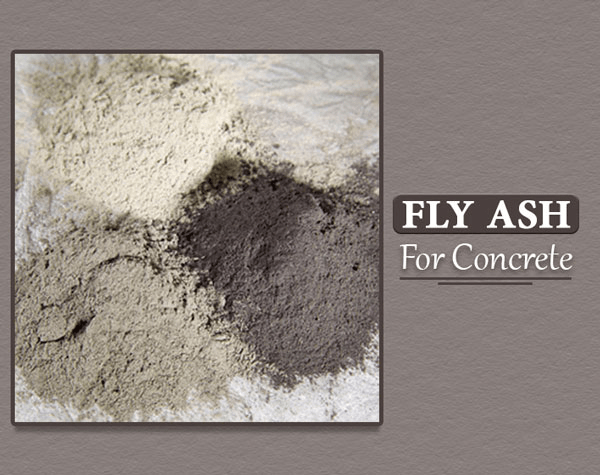
After coal is burned in a boiler, there will be two forms of solid residue – ash and slag. In addition to the solid particles of fly ash collected with flue gas emissions, there are also larger particles in the form of blocks collected from the bottom of the furnace to become furnace bottom slag. Depending on the types of coal burned in coal-fired plants, the fly ash collected and discharged can be divided into low-calcium coal ash and high-calcium coal ash. Any fly ash with a calcium oxide content greater than 8% or a free calcium oxide content greater than 1% is called It is a high-calcium fly ash, so generally, high-calcium ash and low-calcium ash are distinguished by measuring the calcium oxide content or free calcium oxide content in the fly ash. Usually, the color of high-calcium ash is yellowish and low. Calcium gray is grayish in color.
(1) Fineness and particle size
Generally, the particle size of collected fly ash varies from 0.5 to 300 μm, which is close to the range of cement, but most of the particles are much finer than cement.
(2) Specific surface area
Because dense particles in fly ash are mixed with porous particles with large internal surface areas, it is not easy to accurately measure the particle size using the specific surface area method. The variation range of fly ash measured using standard cement-specific surface area is generally 1500-5000cm2/g, which can still be used to reflect the comprehensive internal and external areas of fly ash composite particles.
(3) Particle gradation
It can be divided into three types: fine, coarse, and mixed gray. Fine ash is used in concrete applications.
(4) Density
The density of ordinary fly ash is 1.8-2.3g/cm3, about two-thirds of Portland cement. The fly ash bulk density variation range is 0.6-0.9g/cm3.
(5) Water demand ratio
The fly ash water demand ratio is required when replacing Portland cement with 30% fly ash to the water demand of the Portland cement standard mortar according to the specified cement standard mortar fluidity test method. This property index can reflect the physical properties of fly ash to a certain extent. It can be used to estimate the influence of fly ash on some properties of concrete. The water demand ratio of the worst fly ash can be as high as more than 120%, and the water demand ratio of high-quality fly ash may be less than 90%.
(6) Volcanic activity
In current fly ash standards for concrete used in various countries worldwide, test methods such as “compressive strength ratio” are used to evaluate the volcanic activity of fly ash. This method is improved from the traditional cement mortar strength test method. The activity level of fly ash is assessed based on the contribution of the mixed fly ash to the strength of cement mortar.

 concrete admixture
Leave a comment